Getting South Africa Working
New Resolutions, Affirmations and Motions
New Resolutions
Resolutions are proposals put forward by DA branches, regions, provinces and structures for debate and decision at Federal Congress. They cover a wide range of policy and governance issues and reflect the priorities of DA members from across South Africa.
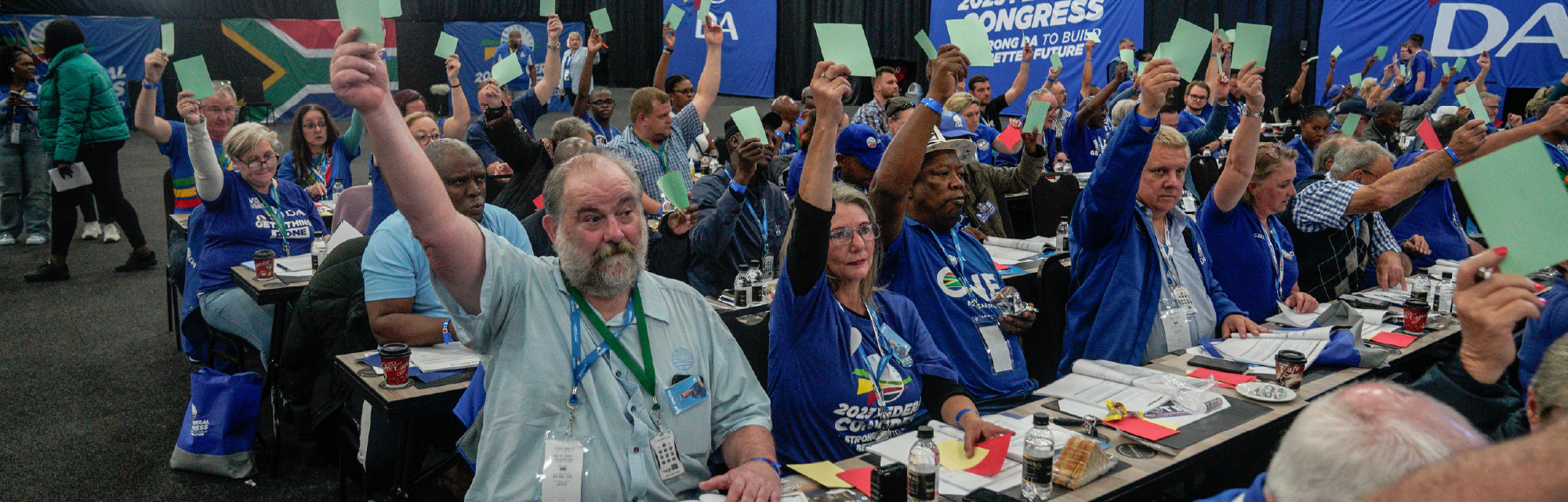
Delegates vote on resolutions during both days of Congress. Resolutions passed at Federal Congress 2026 become part of the DA’s official policy direction.
Title: Introducing Civic Education in Lower Primary Education
Proposer: Cathrine Moletsane Nkuna
Seconder: Eunice Mukhesani
Resolution:
The Party resolves that civic education be introduced as a subject within the basic education curriculum.
Motivation:
This will empower our children with knowledge about their rights, responsibilities, and the functions of government institutions.
Our children can even benefit from:
1. Critical thinking and civic engagement: Civic education can encourage critical thinking, helping learners analyse issues, make informed decisions, and participate in the democratic process.
2. Understanding the constitution and governance: Learners can understand their Constitution, institutions and governance structure, promoting a sense of ownership and responsibility.
3. Addressing socioeconomic challenges: By exploring policy, the policy-making process, learners can develop solutions to pressing issues like inequality, poverty and unemployment.
4. Career opportunities in government and international: Public policy, international relations, journalism and more opportunities within the legislative, districts and municipalities.
5. Promoting tolerance and dialogue: Understanding and constructive debate help bridge the divides in South Africa.
Advisory Opinion:
The Policy and Resolutions Review Committee advises the Federal Congress to vote against this submission for the following reason(s): In post-Apartheid South Africa, we have fostered a culture of apolitical education for our children, which is enshrined by law (Section 33A (1)(2) of the South African Schools Act) that prohibits all forms of political activity in schools. Teachers are currently not trained to foster unbiased political discussions in the classroom, possibly exposing the children to unwanted political views and/or the teacher to possible retaliation from parents with conflicting political views. Young minds can easily be influenced, and therefore, this policy, if implemented, can be misused by political actors to promote their own political opinions in the classroom. It is important that we protect our children from such exposure. Furthermore, civic education is already taught in schools across various grade levels. Although it is not a standalone subject, it is embedded within subjects such as Life Orientation (LO) and Social Sciences (History). However, making it a standalone subject risks politicising the classroom, blurring the line between civic literacy and political advocacy.
Title: Over 35 and Overlooked: The DA Must Address the Employment Age Limit
Proposer: Eunice Mukhesani
Seconder: Cathrine Moletsane Nkuna
Resolution:
In South Africa today, thousands of capable men and women over the age of 35 are struggling to find jobs. Despite having valuable skills, experience and determination, many find their application ignored simply because of their age. Job adverts often favour “young and dynamic” candidates while mature workers are overlooked. This silent form of discrimination has become a crisis that the government and companies can no longer ignore.
The harsh reality of being over 35 and jobless: For many South Africans, turning 35 marks a painful turning point; suddenly, doors that were once open start to close.
Being unemployed at 35 or older can destroy confidence and self-worth. It is not that these individuals are incapable or unwilling to work; it is that the system has decided they are too old.
Here are some steps that could make a real difference:
• Enforce anti-age discrimination laws in recruitment and hiring processes.
• Create re-skilling and upskilling programmes for adults over 35, helping them stay relevant to the modern job market.
• Launch awareness campaigns to challenge stereotypes about age and capability in the workplace.
By implementing such measures, South Africa can promote fairness and tap into a wealth of untapped experience.
Motivation:
Every citizen deserves the right to work, to provide for their family, and to live with dignity. It is time for Democratic Alliance (DA) leaders to take steps for those who have been left behind.
The future of our nation depends not only on empowering youth but also on respecting and utilising the wisdom and experience of those who come before them, and a fair job market values both because progress means leaving no one behind.
Advisory Opinion:
The Policy and Resolutions Review Committee submits this matter to the Federal Congress for deliberation and a vote.
Title: Ethical Governance Charter
Proposer: Refiloe Nt’sekhe
Seconder: Jaco Terblanche
Resolution:
1. Purpose and Vision
The Democratic Alliance (DA) is founded on the belief that public office is a sacred trust.
This Charter affirms the DA’s commitment to clean, transparent, and accountable governance in all spheres of government. It establishes binding ethical principles and operational standards to ensure that every DA public representative — from a councillor, Member of the Provincial Legislature (MPL), to a Member of Parliament (MP) — serves with integrity, fairness, and compliance with the Constitution of the Republic of South Africa.
2. Foundational Principles
• Integrity in Leadership: Every DA representative must act with honesty, consistency, and respect for the law.
• Accountability to the Public: Elected officials are custodians of trust, accountable to citizens first.
• Service before Self: The interests of the people must always come before personal gain.
• Transparency and Open Governance: Decisions and finances must be open, auditable, and • publicly defensible.
• Zero Tolerance for Corruption: Any misuse of public funds or authority is a betrayal of citizens and party values.
3. Ethical Commitments
All DA public representatives shall:
• Sign an Annual Integrity and Accountability Pledge reaffirming adherence to this Charter and the DA Code of Conduct.
• Disclose assets, gifts, and financial interests in accordance with the law and DA ethical standards.
• Undergo lifestyle audits where deemed necessary by the Integrity Unit or Federal Legal Commission.
• Decline any gifts or sponsorships that compromise independence or create conflicts of interest.
• Declare conflicts of interest before participating in any decision-making.
• Report corruption or unethical conduct immediately through formal channels.
• Promote merit-based appointments and reject cadre deployment.
• Champion gender equality, fairness, and human dignity in all governance processes.
• Ensure declarations of interests are submitted timeously for the legislative body they serve.
4. Ethical Governance Structures
The DA public representatives serving in Ethics committees in different spheres of government:
• Monitors compliance with this Charter and issues annual integrity reports.
The Federal Legal Commission (FLC):
• Investigates and adjudicates breaches of ethics and recommends disciplinary measures.
The Federal Council Chairperson
• Ensures that all DA public representatives are compliant with the Charter.
5. Consequence Management
Breaches of this Charter shall trigger an investigation by the FLC.
Sanctions may include:
• Written warning or reprimand.
• Suspension or removal from public office.
• Criminal referral where warranted.
• Repeat or serious offences shall result in expulsion from the DA.
6. Ethical Culture and Training
• Mandatory Ethical Leadership Training for new representatives.
• Annual Integrity Refresher Sessions for senior officials.
• Public ethics education and whistleblower protection promotion in DA-led governments.
7. Public Transparency Commitments
DA governments commit to:
• Publishing all tenders, contracts, and audits online.
• Releasing quarterly expenditure reports.
• Encouraging public participation and oversight in governance.
8. Conclusion
The DA reaffirms that clean governance is not an act of compliance, but an act of character.
This Charter is our solemn promise to South Africans — that every DA representative will govern ethically, transparently, and with unwavering respect for the public trust.
“Integrity is the courage to do what is right — even when no one is watching.”
Motivation:
In a time when public confidence in political leadership is at its lowest, the DA must continue to stand apart — not only for what we deliver, but for how we lead.
Ethical leadership is not optional. It is the foundation on which trust, democracy, and good governance are built. When elected officials act without integrity, the poorest suffer most — because corruption steals directly from service delivery, dignity, and hope.
As public representatives, we hold a sacred trust with the people we serve. Our conduct must always reflect the values we proclaim: honesty, fairness, and accountability.
The DA Ethical Governance Charter is therefore not just an internal policy — it is a public commitment that every DA leader and representative will serve with clean hands, open books, and a clear conscience.
Let this Charter remind us that ethical governance is the true measure of political maturity and moral courage. And let the DA continue to lead South Africa not only by performance, but by principle.
Advisory Opinion:
The Policy and Resolutions Review Committee submits this matter to the Federal Congress for deliberation and a vote.
Title: Medi Pele (Roots First)
Proposer: Tyrone Michael Gray
Seconder: Lesego Lucia Lekoto
Resolution:
Serving as a public representative, in any sphere of government, as a prerequisite, requires demonstrable commitment to structural support for branch formation, facilitation, participation and mobilisation.
Motivation:
Branches, as the building blocks of the Democratic Alliance (DA), are foundational cornerstones for electoral success. The performance of the party is ultimately dependent on properly functioning branches, which are active, engaged and supported. The sustainable development of the organisation requires well-functioning branches and a commitment from all public representatives to ensure successful branch operations and functionality. Talent search must be nurtured to avoid negative consequences from “parachutism.”
Advisory Opinion:
The Policy and Resolutions Review Committee submits this matter to the Federal Congress for deliberation and a vote.
Title: Addressing the Impacts of Online Gambling on South Africans
Proposer: Nicholas Nyati
Seconder: Siyamthanda Luvo Vimbani
Resolution:
The Democratic Alliance (DA) Congress resolves to:
1. Lobby support in Parliament for the DA’s Remote Gambling Bill to establish a regulated framework for online gambling, ensuring consumer protection, responsible advertising, and fair taxation.
2. Advocate for national programmes to combat gambling addiction, including public awareness campaigns, funding for mental health support services, and mandatory self-exclusion tools for online platforms.
3. Call for enhanced enforcement against illegal online gambling operators through collaboration with law enforcement and international regulators.
4. Promote research into the socio-economic effects of online gambling to inform evidence-based policies that safeguard vulnerable South Africans, particularly youth and low-income households.
Motivation:
Noting that:
• Online gambling turnover in South Africa reached R1.5 trillion in 2024/25, with income growing from R10.1 billion in 2018 to R152.6 billion recently, indicating explosive growth amid regulatory gaps.
• According to recent reports, even students spend NSFAS allowances on online gambling.
• South Africans now spend more on gambling than on any other entertainment, contributing to economic extraction and financial strain on households.
• Gambling addiction is fuelling a silent mental health crisis, leading to financial ruin, family breakdowns, and social dysfunction, especially among male breadwinners and unemployed youth.
• Inadequate regulations exacerbate these harms, and the DA’s Remote Gambling Bill offers a pathway to responsible oversight.
Advisory Opinion:
The Policy and Resolutions Review Committee advises the Federal Congress to vote in favour of this submission.
Title: Embedding Preventive Wellness and Support Structures in DA Political Structures
Proposer: Cindy Billson
Seconder: Wendy Alexander
Resolution:
The Democratic Alliance (DA) resolves that:
1. A structured and proactive wellness support framework should be established and standardised across all DA caucuses and structures nationally.
2. The Party promotes preventative wellness strategies to reduce burnout, compassion fatigue, anxiety, and political disengagement among public representatives and political leaders.
3. A core framework be developed that includes:
• Independent wellness service providers with verified professional credentials in trauma-informed care and political workplace dynamics.
• Guaranteed confidentiality and data protection for users.
• Referral pathways for high-risk cases requiring medical or professional intervention.
4. The Party mandates that all political heads (e.g., Whips, Caucus Leaders, Branch Chairs, Constituency Heads) be trained to:
• Identify early signs of burnout and distress.
• Respond in a timely and supportive manner. • Reduce stigma and promote trust in wellness offerings.
5. This resolution supports the expansion of wellness interventions to include: • Peer-support mechanisms and mentoring structures.
• Integration of wellness check-ins as part of regular political management and performance oversight processes.
• Leadership empowerment training and tools to build skills and resilience to support personal wellness and effective leadership.
6. A report on the implementation of this resolution must be tabled at the next Federal Council meeting following Congress.
Motivation:
The emotional and psychological toll of public representation is increasingly evident across political structures. Councillors, Members of Parliament (MPs), Members of Provincial Legislatures (MPLs), and grassroots leaders face elevated stress due to community pressure, service delivery challenges, violence, and online abuse — often without adequate support.
Despite the DA’s commendable rollout of wellness offerings, uptake remains low. Feedback shows that many public representatives feel that existing wellness professionals lack an understanding of the political context and that confidentiality cannot be guaranteed.
By expanding and professionalising wellness structures — while also training leadership to support those at risk actively — the DA will set a national precedent for ethical, compassionate, and sustainable political service. This will safeguard the Party’s most critical resource: its people.
Advisory Opinion:
The Policy and Resolutions Review Committee advises the Federal Congress to vote in favour of this submission.
Title: Vaping Regulations to Safeguard Teenagers
Proposer: Siyamthanda Luvo Vimbani
Seconder: Nicholas Nyati
Resolution:
The DA resolves to:
1. Prohibit the sale of vaping products to individuals under 18 years old.
2. Impose fines and penalties on vendors who sell vaping products to minors.
3. Launch public awareness campaigns to educate teenagers and parents about the risks of vaping.
4. Implement school programmes to prevent vaping, promote healthy lifestyles, and declare schools “No-Vape Zones”.
Motivation:
Noting that:
Vaping has become a significant concern among teenagers, with many accessing vaping products despite health risks. Nicotine consumption can have long-term effects on adolescent brain development, including impaired cognitive function and increased risk of addiction.
Further noting that some of the risks include:
• Brain development: Nicotine can harm adolescents’ brain development, affecting attention, learning, and memory.
• Addiction: Nicotine is highly addictive, and early exposure can lead to lifelong dependency.
• Respiratory issues: Vaping has been linked to respiratory problems, including bronchitis and asthma-like symptoms.
Advisory Opinion:
The Policy and Resolutions Review Committee advises the Federal Congress to vote in favour of this submission.
Title: Affordable Rental Incentives for Youth and First-Time Workers
Proposer: Mncedi Khwezilomso Mathambeka
Seconder: Siyamthanda Luvo Vimbani
Resolution:
The DA will resolve to investigate tax deductions and municipal rebates for landlords who provide affordable rental units to young professionals and first-time workers in urban centres, if fiscally and economically viable.
Motivation:
Noting that youth inclusion in cities drives innovation and economic productivity, this motion encourages the private sector to become an active partner in housing reform. Tax incentives are a market-friendly, non-intrusive mechanism that fits the DA’s belief in opportunity creation through enterprise. It is a pragmatic response to inequality that empowers both landlords and young South Africans.
Advisory Opinion:
The Policy and Resolutions Review Committee advises the Federal Congress to vote against this submission for the following reason(s):
Introducing affordable rental incentives, such as rent freezes for a targeted population group, not only goes against the party’s principles of a free market economy, but it may also cause more harm than good. Case studies have shown that once the government implements rent control, supply collapses, as investors sell their units, and rent in uncontrolled areas (often further away from the business districts) increases as the supply for units decreases.
Once such a policy is implemented, it can heighten inequality as it only benefits those who already have rental agreements, creating an insider class of protected tenants and an outsider class of people wanting to get into those limited rental units. The wealthy cling to artificially cheap units for decades, while the young, the poor, and new arrivals face skyrocketing rents in the uncontrolled segment. These types of measures can also affect the maintenance of rent-controlled units, as low rent collections cannot keep up with the rising cost of maintenance, leaving entire sections of the city with unkept and undesirable housing units, decreasing the quality of living standards for those living there.
Section 10.1 of the DA’s Housing Policy already calls for the following:
• In metropolitan areas, establish a review board consisting of representatives from the major social housing companies, with the goal of identifying opportunities for reform and growth. This review board should guide the development of a reformed policy framework.
• Increase rental housing stock, specifically formulated to assist target sections of the population for which the demand for rental housing is particularly high, including, but not limited to, students, young professionals, single-headed households, and the elderly. For many, such as students and young professionals, rentals satisfy an immediate and interim need for housing whilst they pursue their studies or careers.
• The income thresholds of those who qualify for rental stock and social housing opportunities will be revised annually in line with inflation.
Title: Promoting Inclusive and Non-Religious Terminology in Party Communication
Proposer: Refiloe Nt’sekhe
Seconder: Mabekenyane (Phillip) Thamahane
Resolution:
• The Democratic Alliance (DA) reaffirms its commitment to being a diverse, inclusive, and multi-religious organisation that respects the beliefs and values of all its members.
• The term “tithing” shall not be used in official DA communication or documentation in reference to member financial contributions.
• The term “subscription” shall be used instead, as it reflects a neutral, inclusive, and voluntary contribution made by members to support the work and sustainability of the organisation.
• The Federal Finance Committee and relevant party structures must ensure that all policies, membership forms, and official communications are updated to reflect this terminology.
Motivation:
• The DA represents South Africans of all faiths and beliefs, and therefore must use language that is inclusive and respectful of religious diversity.
• The term “tithing” carries explicit religious connotations, traditionally associated with particular faith practices, which may alienate members who do not share those beliefs.
• By adopting the term “subscription”, the DA aligns with universal democratic and organisational standards that promote equality, inclusivity, and respect for diversity.
• This resolution reinforces the DA’s identity as a modern, non-sectarian, and constitutionally aligned political organisation that values unity and inclusiveness in both principle and practice.
Advisory Opinion:
The Policy and Resolutions Review Committee submits this matter to the Federal Congress for deliberation and a vote.
Title: Commitment to the Legalisation of Safe Relinquishment, Baby Savers and Baby Safe Havens in South Africa as an Alternative to Unsafe Infant Abandonment
Proposer: Alexandra Abrahams
Seconder: Bridget Masango
Resolution:
The Democratic Alliance (DA):
• Supports and advocates for national legalisation of safe relinquishment of babies via baby savers operated by registered child protection organisations and designated baby safe havens in South Africa as a compassionate, humane, practical life-saving solution to infant abandonment.
• Collaborates with registered NGOs and relevant government departments, including Social Development, Health, the South African Police Services and fire stations, to expand and resource these lifesaving facilities, guided by compassion, safety, and child protection rights.
Motivation:
For every one infant found alive, two are found dead in South Africa. This is a painful reality which we must face as a country.
Across our country, too many infants are abandoned in fields, pit latrines, rubbish bins, and on the sides of roads. These stories shock us every time they make the news, but the truth is that they happen more frequently than what is being reported.
The reasons are complex. Stemming from unwanted pregnancies due to sexual assault, gender-based violence, poverty, poor education, lack of access to contraceptives, unsuccessful terminations and lack of government alternatives, to name but a few.
Internationally recognised safe relinquishment laws ensure that an infant is left in a designated safe haven, such as a hospital or police station; or a baby saver which is a secure, ventilated, monitored box, operated by registered child protection organisations where an infant can be safely and anonymously left, knowing the child will be cared for and protected as a child in need of care and protection as per the Children’s Act, 2005.
It further recognises:
• Section 28(1)(d) of the Constitution of the Republic of South Africa, 1996, which affords all children the right to be protected from maltreatment, neglect, abuse, or degradation;
• Section 28(2) of the Constitution, which states that a child’s best interests are of paramount importance in every matter concerning the child; and
• Section 11, which further protects a child’s right to life.
By supporting this resolution, the DA affirms that every infant deserves a chance at life and vulnerable women in crisis have responsible and safe options.
Let us ensure that in South Africa, no baby’s first breath is also their last.
Advisory Opinion:
The Policy and Resolutions Review Committee advises the Federal Congress to vote in favour of this submission.
Title: Agricultural Youth Enterprise Zones
Proposer: Mncedi Khwezilomso Mathambeka
Seconder: Siyamthanda Luvo Vimbani
Resolution:
The Democratic Alliance (DA) propose the establishment of Agricultural Youth Enterprise Zones (AYEZs) in rural and peri-urban areas to promote youth participation in farming, agro-processing, and agricultural innovation through targeted support, training, and start-up financing.
Motivation:
Noting that sustainable rural development requires empowering a new generation of farmers, the DA should champion this motion as a job creation and food security strategy. By leveraging partnerships with private agribusinesses, universities, and provincial governments, AYEZs can modernise agriculture and attract youth talent. This aligns with the DA’s focus on entrepreneurship, decentralised governance, and innovation-driven economic growth.
Advisory Opinion:
The Policy and Resolutions Review Committee submits this matter to the Federal Congress for deliberation and a vote.
Title: Access to Sanitary Products for Girls in Schools
Proposer: Refiloe Nt’sekhe
Seconder: Salamina (Sally) Nene
Resolution:
• The Democratic Alliance (DA) calls on national and provincial governments to provide free sanitary products in all public schools.
• The DA will advocate for ring-fenced “Sanitary Dignity Budgets” to prevent diversion of funds and ensure direct benefit to girl learners.
• DA-led governments will partner with the private sector and NGOs to roll out sanitary pad drives and menstrual health education programmes.
• The DA commits to promoting policy inclusion of menstrual health as part of comprehensive learner well-being and gender equality programmes.
Motivation:
• Thousands of schoolgirls miss classes each month due to a lack of access to sanitary pads, impacting their dignity, confidence, and academic performance.
• Menstrual dignity is a human right, not a luxury — it promotes equality, attendance, and empowerment.
• This resolution aligns with the DA’s values of fairness, opportunity, and social justice for all children.
Advisory Opinion:
The Policy and Resolutions Review Committee advises the Federal Congress to vote in favour of this submission.
Title: Building Safe, Nurturing, and Violence-Free Schools for South Africa’s Children
Proposer: Refiloe Nt’sekhe
Seconder: Salamina (Sally) Nene
Resolution:
• The Democratic Alliance (DA) calls for the urgent implementation of comprehensive school safety audits and the deployment of trained, vetted safety officers in all public schools, prioritising high-risk areas.
• The DA supports the establishment of dedicated psychosocial support teams in every education district to proactively address bullying, abuse, trauma, gender-based violence, substance abuse, and mental health challenges among learners and staff.
• The DA will promote formal partnerships between schools, parents, civil society, community policing forums, and local law enforcement to create safe, nurturing, and rights-based learning environments.
• The DA will advocate for the strengthening of School Governing Bodies (SGBs), ensuring that their disciplinary rulings on incidents of violence, bullying, or abuse are respected and upheld by the Department of Education and not arbitrarily overturned.
• The DA calls for the adoption of a national policy on school-based violence prevention, which includes:
– mandatory reporting and consequence management for all incidents of violence or abuse,
– anti-bullying and conflict management programmes from Foundation Phase upward, and
– the integration of life skills and emotional intelligence into the school curriculum.
• The DA will continue to champion safe, well-maintained infrastructure, effective reporting lines, and accountability mechanisms for both educators and officials who fail to protect learners.
• The DA reaffirms that every learner and educator has the right to physical, emotional, and psychological safety to pursue learning and teaching free from fear.
Motivation:
• Violence, bullying, and abuse in South African schools have escalated sharply, with recent incidents of fatal assaults, sexual violence, and intimidation eroding public confidence in the education system.
• Teachers and learners alike face threats to their safety, resulting in trauma, absenteeism, and declining academic performance.
• SGBs are best positioned to uphold discipline and community standards, but are often undermined by departmental interference and lack of enforcement.
• Every child has a constitutional right to safety, dignity, and education in a secure environment. • This resolution strengthens the DA’s commitment to a compassionate, opportunity-driven society where schools are sanctuaries of learning — not sites of fear and violence.
Advisory Opinion:
The Policy and Resolutions Review Committee advises the Federal Congress to vote in favour of this submission.
Title: Resolution on Internal Maternity and Parental Leave for Public Representatives Policy and Advocacy for Parental Workplace Rights in South Africa
Proposer: Ciska Jordaan
Seconder: Alexandra Abrahams
Resolution:
The DA resolves to:
• Support the development and adoption of an internal maternity and parental leave policy applicable to all public representatives.
• Ensure that the policy, applicable to DA public representatives, is a reflection of:
– The Party’s values, principles and policies.
– A commitment to ensuring fair performance measurement of public representatives if and when the assessment periods consider a period in which the representative was on maternity or parental leave.
– Internal and external best practices on the matter.
• Aim to adopt the policy uniformly throughout its structures, ensuring it applies to Members of Parliament (MPs), Members of Provincial Legislatures (MPLs) and Councillors, in respect of their Party-political work, whereas their leave for legislative work would be prescribed by the legislative body in which they serve (municipal, provincial or national).
• Initiate and/or support the implementation of fair maternity and parental leave policies for public representatives in councils where these do not exist.
• Supports efforts that advance and advocate for fairness, equality, job security and economic sustainability in the South African workplace for parents of newborn and adopted babies and children.
Motivation:
Research consistently highlights the immense importance of parental leave for parents of newborn and/or adopted babies and children. Not only does parental leave support postnatal recovery, familial adjustment and bonding with a new family member, but it also has a proven long-term impact on the development of a child, security of a family and addressing gender-related workplace inequalities.
Modelling Fairness, Opportunity and Equality
As a Party of government, promoting fairness, opportunity and equality before the law, the DA has a responsibility to model and advocate for progressive workplace practices that encourage gender equity and economic justice in action. Though the Party’s employees uphold the Basic Conditions of Employment Act (1997) (BCEA) and standard labour relations practices from an HR perspective, currently, there is no known clear or consistent internal policy regarding maternity or parental leave for public representatives when it comes to the various facets of their work – bearing in mind that they are appointed by the Party but technically, employed by the legislature in which they serve.
A uniform standard across the country does not seem to currently exist. In practice, arrangements for public representatives differ across provinces and levels of government. It is found that in some provinces, public representatives arrange amongst themselves to ‘stand in’ for others while they tend to their newborn children for an extended period; in others, there is an unspoken expectation to work remotely without clarity on whether the same performance targets are applicable during the period of time that a representative is on leave from his/her legislature. In some caucuses, maternity or general leave is covered in caucus rules, while in others, public representatives have the practice of informing their provincial leadership of their personal circumstances without any clear direction, whether ‘leave’ time is permitted or whether they are expected to be available to some extent. This also differs where the DA is in government, whether the representative is a ward or PR councillor, MPL or MP and may differ with regards to legislative work vs Party work.
The Status Quo for South Africans – Advocating for Fairness and Equality in the Workplace
Though the BCEA does provide a measure of protection for maternal rights when it comes to discrimination against pregnant women and a minimum entitlement of leave, the Act does not adequately address other parental rights sufficiently, such as in the case of adoption, surrogacy, paternity, single parenthood and parenthood within the LGBTQ+ community. This is not only an injustice in terms of fairness and equality, but also does not consider the adverse impact on babies and children of such parents, who have the same need to be nurtured, protected and cared for.
In line with this, the DA’s Economic Justice Policy has envisioned a modernised parental leave system, with a proposal for 6 weeks of maternity leave and 10 weeks of shared parental leave. Though this is a very positive step in the right direction when it comes to workplace equality, there is room for exploration and benchmarking (for example, from the public and private sector, including proposals and policies of European sister parties) towards improving policy with relation to protecting parental rights on this topic.
Many factors surrounding leave from work for parents of newborn babies and adopted children could have a long-term impact on the development of a child. The Party should advocate for fairer practices with regard to this for all South African families, in the spaces where we do have reach, in an economically and equitably sustainable and fair way.
Advisory Opinion:
The Policy and Resolutions Review Committee advises the Federal Congress to vote in favour of this submission.
Title: Commitment to Continuously Improve the DA’s Relationship with Traditional Leaders and the Traditional Leadership Sector
Proposer: Thamsanqa Mabhena
Seconder: Désirée Van Der Walt
Resolution:
• Federal Congress notes that following the approval of a Federal Council Motion in June 2024, a motion proposed by Thamsanqa Mabhena MP and seconded by Dean Macpherson MP, the Federal Council supported the establishment of the Committee on Rural Communities and Traditional Leadership Relations.
• A presentation was made to the Federal Executive (FedEx) on the 14th of April 2025 on the Democratic Alliance’s (DA) relationship with the traditional leadership sector. In that meeting, FedEx decided that more information was needed before a decision on the DA’s approach could be made.
• As such, this set out a series of selected provincial consultations to test the idea and get feedback on whether the sector was eager to work with the DA more closely and collaboratively and what that relationship should be like. This triggered a wide-ranging consultative process that was headed by Thamsanqa Mabhena MP and HRH Zwide Nxumalo KaBhekuzulu, which was meant to engage with traditional leaders across the country.
• This process saw the team traverse four provinces in a consultative process with traditional leaders and stakeholders in the sector. The main question under investigation was whether the DA is doing enough to represent and champion the interests of traditional leaders.
• Given the outcome of this consultative process, the Federal Congress resolves to establish a Traditional Leadership and Rural Communities Operational Directorate within the office of the Federal Council Chairperson, under the Whole of Society Approach strategy. The finer details are to be determined by the Federal Council Chairperson.
• This operational directorate will be dealing with specialised programmes in the sector and will be tasked with the coordination of strategic engagements and events that will give the party access to the traditional leadership sector, without the burden of an ancillary organisation. The proposal is that the party appoint a fit-for-purpose consultant/staff member(s) to deal with and engage with the sector and coordinate its programmes nationally. This allows the party to retain full control over the messaging and activities of this operational directorate.
Motivation:
• Of the engagements that we conducted with traditional leaders, the sentiment was overwhelmingly positive. The DA is respected as an effective and vicious issue-driver, and the DA’s track record in government stood out.
• As such, our stakeholders believe that if the DA can take up many of the issues and concerns that affect the traditional leadership sector, it would make a difference.
• They indicated that they have lost faith in the ruling party. Our engagements centred mostly around service delivery challenges and the lack of development for rural communities, including poorly managed and unresolved traditional leadership succession processes.
Advisory Opinion:
The Policy and Resolutions Review Committee advises the Federal Congress to vote in favour of this submission.
Title: Expand the Proposed Student Funding Model to Reach a Wider Number of Households
Proposer: Pogiso Mthimunye
Seconder: Gilbert Monnanyana
Resolution:
The DA will expand each tier of the proposed national funding model by amending the qualifying criteria to account for inflation from 2023, with annual adjustments based on inflation. The current banded funding model, which is to be adjusted, is as follows:
1. Tier one: R0 – R180 000 – 100% funding
2. Tier two: R180 001 – R350 000 – 66% funding
3. Tier three: R350 001 – R600 000 – 33% funding
Motivation:
The cost of living has left many households scrambling and surviving on basics. Education has become very expensive for poorer households. This resolution will expand access to higher education for even more families in South Africa.
Advisory Opinion:
The Policy and Resolutions Review Committee advises the Federal Congress to vote in favour of this submission.
Title: Democratic Alliance Commitments to Intentional Inclusion of Persons with Disabilities in Government and Opposition
Proposer: Refiloe Nt’sekhe
Seconder: Salamina (Sally) Nene
Resolution:
Promote legislation and policies to ensure that all government departments and operations, including education, recreation, employment, and public transportation, are intentionally inclusive and accessible to persons with disabilities across all disability categories. This includes persons with physical, sensory, intellectual, psychosocial, neurological, and other disabilities, both visible and invisible.
Motivation:
The Democratic Alliance (DA) recognises that despite progress made in promoting equality and accessibility, persons with disabilities continue to face significant barriers in various aspects of life. It is essential that we acknowledge the importance of creating an inclusive environment that enables persons with disabilities to participate fully and equally in all areas of society. The intentional inclusion of persons with disabilities is not only a moral imperative but also a constitutional requirement. By promoting accessibility and inclusivity, we can unlock the potential of persons with disabilities, promote social and economic development, and create a more just and equitable society. Persons with disabilities face numerous challenges, including inaccessible public transportation, a lack of accessible educational materials, and limited job opportunities. Furthermore, recreational facilities and public spaces often fail to provide adequate accommodations, excluding persons with disabilities from participating in social and cultural activities. The DA is committed to promoting the rights and dignity of persons with disabilities. We recognise that intentional inclusion requires a comprehensive approach that involves all government departments and operations. Therefore, we propose that all government departments and operations take concrete steps to ensure that their policies, programmes, and services are accessible and inclusive to persons with disabilities.
Advisory Opinion:
The Policy and Resolutions Review Committee advises the Federal Congress to vote in favour of this submission.
Title: Farm to Market Infrastructure Development
Proposer: Mncedi Khwezilomso Mathambeka
Seconder: Siyamthanda Luvo Vimbani
Resolution:
The Democratic Alliance (DA) supports targeted investment in rural roads, storage, and irrigation infrastructure to improve farm-to-market access, reduce post-harvest losses, and stimulate agricultural value chains.
Motivation:
Noting that infrastructure investment is the foundation of inclusive economic growth, the DA should back this motion as a non-partisan, practical solution for rural upliftment. Improving logistics networks will attract private investment, increase farmer income, and stabilise food prices. This policy fits squarely within the DA’s agenda for effective governance, efficient infrastructure rollout, and equitable access to opportunity.
Advisory Opinion:
The Policy and Resolutions Review Committee advises the Federal Congress to vote in favour of this submission.
Title: Rapid Rural Development Strategy
Proposer: Mncedi Khwezilomso Mathambeka
Seconder: Lwazi Jakalase
Resolution:
The Democratic Alliance (DA) calls for a Rapid Rural Development Strategy focused on economic infrastructure, local entrepreneurship, and essential service delivery to reduce rural poverty and bridge the urban–rural divide.
The framework will prioritise:
1. Rural road and digital connectivity infrastructure, including broadband access, to enable participation in the Fourth Industrial Revolution and unlock rural economic activity.
2. Skills training and micro-enterprise support for out-of-school youth and adults.
3. Partnerships with traditional leaders, farmers, the private sector, and non-governmental organisations (NGOs) to deliver services efficiently.
4. Development of new economic pathways in line with the economic offerings of the respective regions.
Motivation:
Noting that:
• Rural neglect perpetuates inequality and internal migration pressures; the DA should champion a results-driven, partnership-based approach to rural growth.
• This motion supports the DA’s belief in building opportunity rather than dependency, empowering rural citizens through enterprise, not handouts.
• A Rapid Rural Development Strategy would showcase the DA as the party capable of transforming rural South Africa into hubs of production, innovation, and sustainable livelihoods, ensuring that no community is left behind.
Advisory Opinion:
The Policy and Resolutions Review Committee advises the Federal Congress to vote in favour of this submission.
Title: Teenage Pregnancy and Statutory Rape in South Africa
Proposer: Nicholas Nyati
Seconder: Siyamthanda Luvo Vimbani
Resolution:
The Democratic Alliance (DA) Federal Congress resolves to:
1. Call on the South African government to declare teenage pregnancy and statutory rape a national crisis, mandating immediate multi-sectoral interventions, including mandatory reporting of pregnancies in girls under 16 to law enforcement for investigation of statutory rape.
2. Commit the DA to advocate for enhanced comprehensive sex education in all schools, starting from Grade 4, with a focus on consent, rights, and reporting mechanisms, integrated into the national curriculum by 2026.
3. Call for the establishment of specialised Thuthuzela Care Centres in every district, equipped with forensic capabilities, psychological support, and fast-track prosecution units to handle child sexual offences, with a target of reducing case backlogs by 50% within two years.
4. Mandate DA provincial structures to partner with NGOs for community awareness campaigns targeting rural areas, emphasising intergenerational dialogue to prevent exploitative relationships and promote girls’ education and economic empowerment.
Motivation:
Noting that:
1. South Africa faces an alarming surge in teenage pregnancies, with over 122,000 teenagers giving birth in the 2023/2024 financial year, including 2,716 girls aged 10-14, according to Department of Health data cited by the DA in August 2024.
2. Nearly 365 teenagers give birth daily, with 10 of these involving girls under 15, as revealed in the 2024 District Health Barometer, perpetuating cycles of school dropout, unemployment, and intergenerational poverty.
3. Statutory rape underpins many of these cases, with over 106,000 child rape incidents reported between 2018 and 2024, averaging 17,666 annually, per DA analysis of SAPS statistics in October 2024. Yet, conviction rates remain below 10% due to systemic failures in investigation and prosecution.
4. KwaZulu-Natal alone recorded 26,515 teenage pregnancies from April to December 2024, highlighting regional hotspots and the urgent need for targeted enforcement against predatory older men.
5. These crises disproportionately affect black and rural girls, exacerbating inequality and undermining South Africa’s demographic dividend, as adolescents (10-19) comprise 17.4% of the population per Stats SA 2022 data, with updated 2024 figures showing persistent high risks of HIV and maternal mortality.
Advisory Opinion:
The Policy and Resolutions Review Committee advises the Federal Congress to vote in favour of this submission.
Title: Upgrading of Sewage Treatment at Marine Outfalls
Proposer: Lori Cynthia Coogan
Seconder: Jacques Hoon
Resolution:
The United Nations (UN) Sustainable Development Goal (SDG) 6 relates to Water and Sanitation. The goal is to reduce pollution and halve the release of untreated wastewater by 2030. SDG 14, which relates to Life Below Water, targets the prevention of Marine Pollution and Protecting Coastal Ecosystems. So, the marine outfalls along our coastline, where raw, untreated sewage flows into the sea, need to be audited.
As coastal populations have increased in size, the amount of sewage flowing into the ocean has also increased. We will determine which marine outfall sewage pipes should be initially prioritised for upgrading.
There are several options for treating sewage, including bioremediation – where benign bacteria digest the sewage, prior to the outfall pipes – or new-age modular Wastewater Treatment Works (WWTW) technology, which is compact yet effective and can be constructed before the outfall pipes begin. This compact WWTW will treat the sewage before it flows out to the ocean, rendering it harmless to the receiving environment.
Motivation:
Cities are currently polluting our oceans, particularly coastal municipalities where the flow of untreated sewage into the ocean is heavier than in less populated areas. This can have a negative effect on the health of the ocean with the contamination of both the seawater and the marine life within it. Of particular concern are the forever chemicals that have been found in tests of both sedentary marine life and fish.
Cleaner, healthier oceans are also positive for tourism, which includes swimming, surfing and kayaking.
Tourism is a major source of jobs and has been impacted in particular in KwaZulu-Natal (KZN) by greater volumes of sewage entering the ocean, due to infrastructure that was damaged during recent floods.
As a key priority of the Democratic Alliance (DA), any issue that will affect employment by reducing business and jobs generated by tourism will be a priority to resolve.
Advisory Opinion:
The Policy and Resolutions Review Committee advises the Federal Congress to vote in favour of this submission.
Title: Survivor-Centred Response to Gender-Based Violence (GBV)
Proposer: Refiloe Nt’sekhe
Seconder: Phuti Kwenaite
Resolution:
The Democratic Alliance (DA) calls for urgent national reform to strengthen South Africa’s response to Gender-Based Violence (GBV) and to ensure that justice favours survivors, not perpetrators.
1. The DA calls for a national investigation into GBV conviction rates to identify systemic failures from police investigation to court prosecution, beginning with police stations such as Tembisa Rabasotho, where 800 cases were opened, 500 made it to court, and only 15 resulted in a conviction.
2. The DA further calls for targeted accountability measures for prosecutors and investigators in GBV cases where evidence is clear, but convictions fail.
3. Survivors must have access to safe, secure environments, receive free legal and psycho-social support and be prioritised in the allocation of housing and protection services.
Therefore, the DA commits to tabling legislative amendments to the Criminal Procedure Act and Domestic Violence Act to enforce these measures and to ensure that justice is survivor-centred and effective.
Motivation:
South Africa faces an unrelenting epidemic of Gender-Based Violence (GBV).
Every day, women, children, and vulnerable persons are violated — often by individuals known to them — and yet very few victims come forward to open cases. Those who do are too often failed by a justice system that grants bail to perpetrators, delays trials, and delivers few convictions.
The case of Tembisa Rabasotho Police Station highlights this crisis starkly: Of 800 GBV cases opened, only 500 were enrolled in court, and a mere 15 convictions were secured. This means that less than 2% of reported cases led to justice — sending a devastating message to perpetrators that they can act with impunity, and to survivors that the law will not protect them.
This lack of consequence not only re-traumatises victims but also demoralises the dedicated police officers who risk their lives to make arrests and gather evidence, only to see their efforts undone by weak prosecutions and poor case management.
To change this trajectory, the DA must lead the call for a survivor-first justice model that:
• Prioritises the removal and detention of perpetrators over the displacement of victims;
• Strengthens investigative and prosecutorial standards; and
• Restores public trust in the justice system’s ability to protect the vulnerable and punish the guilty.
As a party rooted in the rule of law, human dignity, and accountability, the DA must advocate for urgent reforms to ensure that no survivor is failed twice — first by their abuser, and then by the system meant to protect them.
Advisory Opinion:
The Policy and Resolutions Review Committee advises the Federal Congress to vote in favour of this submission.
Affirmations
Title: A Vision for a Better South Africa: Opportunity for All
Proposer: John Steenhuisen
Seconder: Siviwe Gwarube
Resolution:
Preamble
Whereas the Democratic Alliance (DA) reaffirms that the Constitution of the Republic of South Africa is the foundation of our democracy, guaranteeing the rights and freedoms of every individual;
And whereas South Africa faces deepening inequality, high unemployment, and a crisis of governance that has eroded the promise of freedom and justice for all;
And whereas the DA believes that a prosperous and safe society can be built only when every citizen enjoys both equal opportunity and equal justice; Therefore, be it resolved that this resolution is an important component of the DA’s vision for a better South Africa.
Opportunity for All
1. The DA commits to building a South Africa in which every person has the freedom and means to realise their potential, regardless of race, background, or birthplace.
2. The DA recognises that opportunity is created when government empowers individuals (not when it controls them) and that growth begins when citizens are free to innovate, work, and thrive.
3. The Leader of the DA shall champion an “Opportunity for All” Compact, a social and economic agreement built on:
• Quality education and literacy as the foundation of opportunity;
• Job creation through enterprise, not state dependency;
• Empowerment based on disadvantage and need, not race or political connection; and
• Efficient and accountable public services, supported by good governance.
4. The DA reaffirms that sustainable progress requires accountability, efficiency, and transparency in government, ensuring that every public decision expands opportunity for ordinary South Africans.
Motivation:
This resolution reaffirms the DA’s constitutional vision of a South Africa where every person has the freedom and means to realise their potential. It responds to the deep inequality, unemployment and failed governance that have denied opportunity to millions.
Title: A Vision for South Africa: Justice for All
Proposer: John Steenhuisen
Seconder: George Michalakis
Resolution:
Preamble
Whereas the Democratic Alliance (DA) reaffirms that the Constitution of the Republic of South Africa is the foundation of our democracy, guaranteeing the rights and freedoms of every individual;
And whereas South Africa faces deepening inequality, high unemployment, and a crisis of governance that has eroded the promise of freedom and justice for all;
And whereas the DA believes that a prosperous and safe society can be built only when every citizen enjoys both equal opportunity and equal justice;
Therefore, be it resolved that this resolution is an important component of the DA’s vision for a better South Africa.
Justice for All
1. The DA reaffirms that the Constitution and the rule of law are non-negotiable, and that justice must apply equally to all, without fear or favour.
2. The DA demands the timely investigation, prosecution, and conviction of all those found to have engaged in corruption, state capture, or abuse of public resources, regardless of political affiliation or office held.
3. The DA supports the tabling and initiation of legislative and parliamentary measures to strengthen prosecutorial independence.
4. In all DA-led governments, any public representative or official formally charged with corruption or fraud shall be immediately suspended pending the outcome of legal proceedings.
5. Every DA government shall adopt a Public Integrity Framework, ensuring open tender processes, mandatory asset declarations, and transparent audit outcomes accessible to the public.
6. The Leader of the DA shall spearhead a “Justice for All” Campaign to restore public confidence in the criminal justice system, hold the President and law enforcement authorities accountable, and ensure that those who looted the state face the full consequences of the law.
7. The DA believes that a safe South Africa begins with a fair South Africa, and that equal justice is the moral foundation of a society built on integrity, accountability, and opportunity for all.
Motivation:
The resolution reaffirms the DA’s unwavering commitment to the Constitution, the rule of law, and equal justice for every South African. In a country where corruption, state capture and political interference have destroyed public trust, the DA stands for a justice system that is truly independent, fair and fearless.
Title: Reaffirmation of Support for Animal Welfare in DA Administrations
Proposer: JP Smith
Seconder: Wendy Alexander
Resolution:
Noting the commitment by the 2023 DA Federal Congress to supporting animal welfare organisations in local, provincial or national government administrations controlled by the DA or in which the DA are part of a governing coalition, the DA reaffirms its commitment to ensuring that:
1. Such administrations actively engage and support the animal welfare sectors;
2. which shall include establishing an animal welfare forum, similar to the Cape Animal Welfare Forum (CAWF) in the Western Cape, and
3. ensuring duly appointed representatives of the administration meet with that forum at least once a quarter; and 4. such DA administrations undertake such actions, agreements and projects, within the reasonable constraints of budget and legislative authority, to support and enhance the work done by animal welfare organisations active within their jurisdictions.
The Congress further resolves to monitor the implementation of the resolution adopted in 2023 and to report to the Federal Council within 6 months after the Congress on the implementation of the 2023 resolution, whereafter the Federal Council will receive reports every 6 months on the progress in various DA and DA-led coalition administrations of the implementation of this resolution, serving before this Congress.
Motivation:
Animal welfare is important to many people in South Africa in all communities who care about their domestic companions as well as other animals. Improving the health of animals in communities is also important in improving the health and welfare of the people in those communities. The DA resoundingly acknowledged this in a resolution adopted at Congress in 2023, and this resolution calls for the reaffirmation of that resolution, but expands thereon and adds monitoring mechanisms and timeframes to ensure the effective implementation thereof wherever the DA has influence in government.
Title: Promoting Ethical Leadership and Accountability Among Public Representatives
Proposer: Refiloe Nt’sekhe
Seconder: Hector Bogopane
Resolution:
• The Democratic Alliance (DA) recommits to embedding ethical leadership as a non-negotiable standard for all its public representatives across all spheres of government.
• All DA public representatives must sign and publicly declare an annual Integrity and Accountability Pledge, committing to transparency, zero tolerance for corruption, and compliance with the DA’s Code of Conduct and relevant South African legislation governing Ethical behaviour.
Motivation:
• Ethical leadership is the foundation of good governance and public trust.
• South Africa’s governance failures are rooted in ethical decay, abuse of office, and a culture of impunity.
• The DA must lead by example, proving that clean governance is not a slogan but a standard.
• This resolution reaffirms the DA’s commitment to transparent, accountable, and values-driven leadership at all levels.
Title: Commitment to the Core Work of DA Public Representatives
Proposer: Thavha Maifala-Masebe
Seconder: Zondi Makhubela
Resolution:
All DA public representatives, irrespective of additional responsibilities, shall remain committed to prioritising their work in branches and constituencies.
All DA public representatives will always endeavour to build strong party structures by being hands-on in branches and constituencies.
Motivation:
Public Representatives are primarily elected to build party structures.
Branches and Constituencies are the backbone of the party, and that is where the party’s election machinery originates from.
Title: Implementing Cost-of-Living Support Measures Across All Levels of Government
Proposer: Pogiso Mthimunye
Seconder: Ofentse Madzebatela
Resolution:
The DA in government, coalition and opposition will introduce cost-of-living support measures across all levels of government.
Motivation:
The cost of living is driving many South Africans into poverty. Any measure to help cushion South Africans against the cost-of-living crisis would be welcomed by the majority of South Africans.
Motions
Title: Congratulate the Western Cape Agricultural Sector
Proposer: Noko Masipa
Seconder: Thomas Walters
Resolution:
The Democratic Alliance (DA) extends its congratulations to the Western Cape agricultural sector and the Western Cape Department of Agriculture for their continued leadership in research, development, and innovation. This has resulted in a remarkable 3% growth in agricultural exports, significantly increasing the sector’s net contribution to South Africa’s total exports. The Western Cape’s agricultural export contribution to national agricultural exports has risen from 55% to 58%, demonstrating a substantial impact, especially considering the province’s 10% population and 10% geographical space with limited arable land. We also congratulate the Western Cape Department of Agriculture and all agricultural commodity groups, including Hortgro, Cape Wine, South Africa Table Grape, Agri Western Cape, and the Western Cape Agriculture Chamber of Commerce. Furthermore, we extend our sincere congratulations to the agricultural workers, who are the backbone of this vital sector.
Motivation:
Despite the tough geopolitical challenges, the agriculture sector has remained resilient and continued on an upward trajectory. This is largely due to the Department of Agriculture’s support in creating a collaborative platform for stakeholders to resolve their issues, including challenges with ports and electricity. For example, the Department of Agriculture and the fruit industry jointly purchased a generator to support port operations, ensuring that perishable goods are not wasted due to blackouts. Additionally, the Western Cape Government has been proactive in representing farmers through diplomatic engagements and trade missions to promote agricultural products from the Cape.
Title: DA Congress Congratulates DASO Nelson Mandela University on Flagship Victories
Proposer: Mncedi Khwezilomso Mathambeka
Seconder: Lwazi Jakalase
Resolution:
1. The Democratic Alliance (DA) congratulates the DA Student Organisation (DASO) Nelson Mandela University (NMU) on achieving back-to-back Student Representative Council (SRC) election victories, a remarkable milestone and the first time in over a decade that such consistency has been achieved.
2. DASO NMU continues to stand as a flag bearer of the DA’s values within institutions of higher learning, demonstrating what principled, service-driven student leadership looks like.
3. This victory is a testament to the dedication, discipline, and hard work of both past and current activists who have kept the DASO banner flying high, even in challenging political terrain.
4. The DA Federal Congress extend its heartfelt congratulations to President Somila Komani and her incoming executive, and all the best, great success in their term of office as they continue to champion student-centred governance, accountability, and opportunity for all.
Motivation:
1. It is important that the DA and DASO family recognise and celebrate DASO NMU as one of the few DASO structures consistently winning SRC elections across the country.
2. Their continued success keeps the DA’s liberal values alive on campuses, inspiring new leaders and proving that good governance, credibility, and consistent activism earn trust and victory.
3. Celebrating DASO NMU’s achievement is not only a recognition of their success but also a reaffirmation of our collective commitment to rebuilding DASO into a strong, competitive student movement across South Africa.
Title: Acknowledgement of the stellar contribution by our colleagues Anchen Dreyer, John Mendelsohn and Dennis Hunt made to the Democratic Alliance (DA) and ultimately South Africa
Proposer: Thamsanqa Mabhena
Seconder: Désirée van der Walt
Resolution:
The Federal Congress notes and extends warm appreciation to our longstanding members of the DA Johannesburg region. Even long after their official retirement as public representatives, they continue to dedicate much of their time to official party business in various capacities, ranging from Federal to provincial and regional responsibilities. They carry out these duties voluntarily.
Motivation:
These colleagues collectively possess decades of service to both our country and our party, the DA. We recognise and deeply appreciate their contributions, giving them their flowers while they can still smell them. We thank them for their exemplary and selfless leadership, as well as their unwavering dedication to the country and the party. May their hard work continue to inspire even the younger generation to approach public service with the same spirit of selflessness.
Title: Celebrating DA Gauteng’s Helen Suzman Training Academy
Proposer: Thavha Maifala-Masebe
Seconder: Pogiso Mthimunye
Resolution:
1. Congratulate the DA in Gauteng for their successful inaugural year of the DA Gauteng Helen Suzman Training Academy.
2. Along with the leadership of the province, Congress congratulates the first Cohort of the DA Gauteng Helen Suzman Training Academy on their achievement.
Motivation:
1. The DA in Gauteng implemented a professional academy at a very high level of excellence.
2. The academy, being the first of its kind, in that age restriction is not a consideration.
DA Federal Congress • Getting south africa working •DA Federal Congress • Getting south africa working •